
The Flat Files
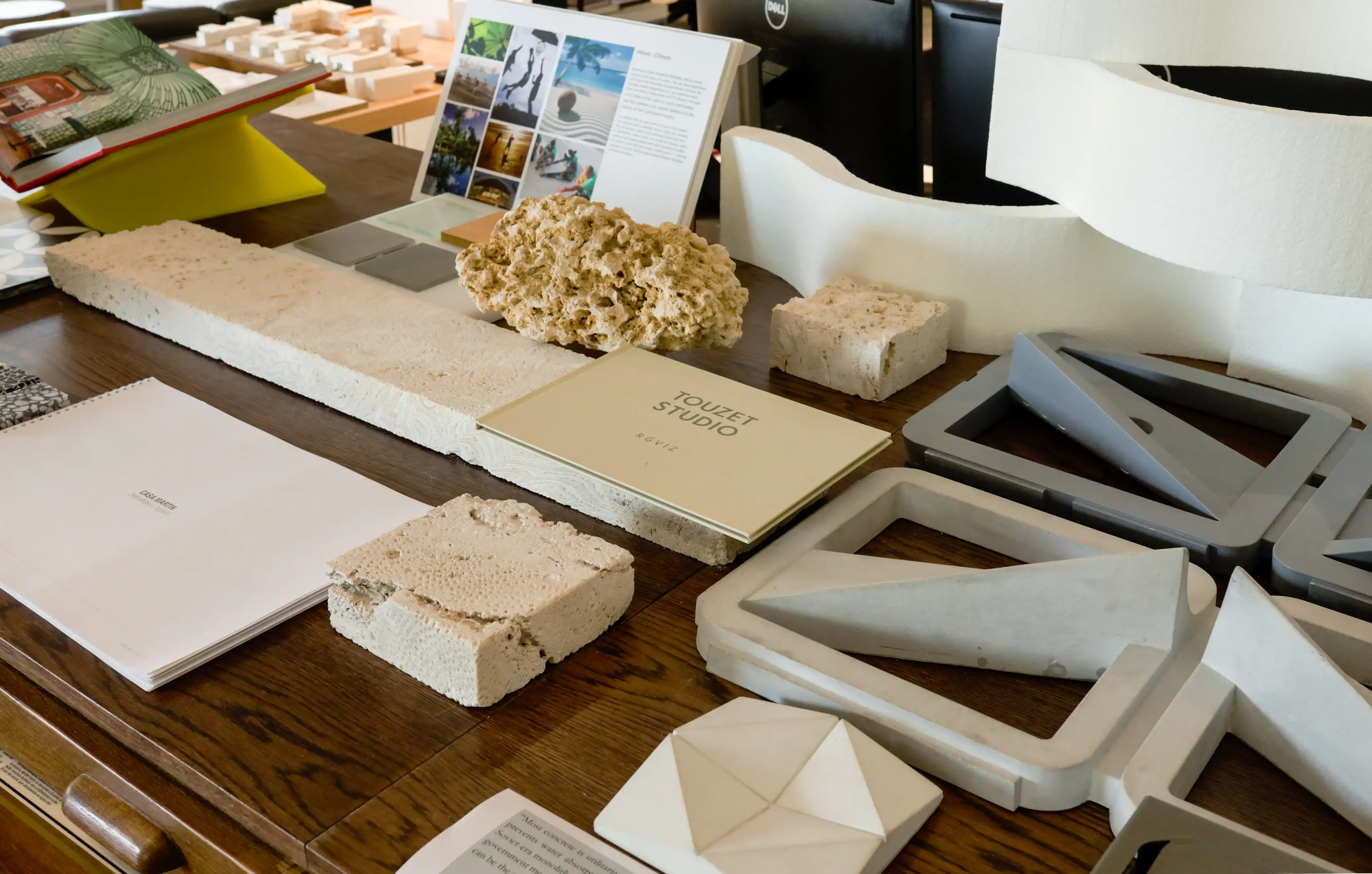
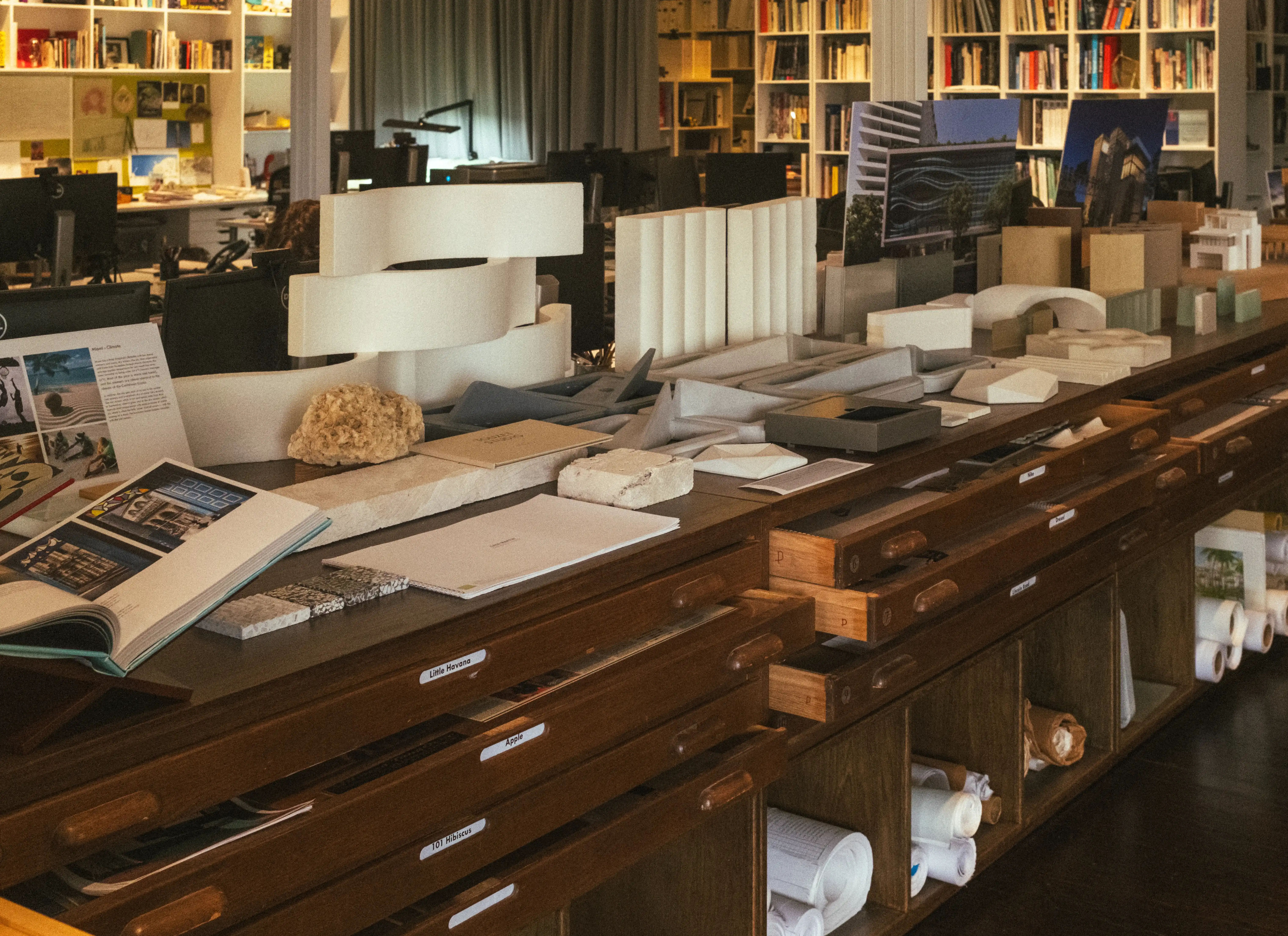
At the front of our studio in Little Havana there isa long row of vintage flat files. The drawers still hold drawings, but the topshave become something else. Over the years they have filled up with pieces ofbuildings.
There is keystone, the fossil coral that sits under so much of South Florida, in raw chunks and in cut slabs. There are GFRC modules, heavy and precise, from screens we developed for Nike. There are samples of terrazzo we love, fluted and textured glass, cast shapes, extruded profiles in wood tones and sand tones, custom bronze, and a fair number of experiments that did not work out. We keep those too. Sometimes a failed sample teaches more than a successful one.
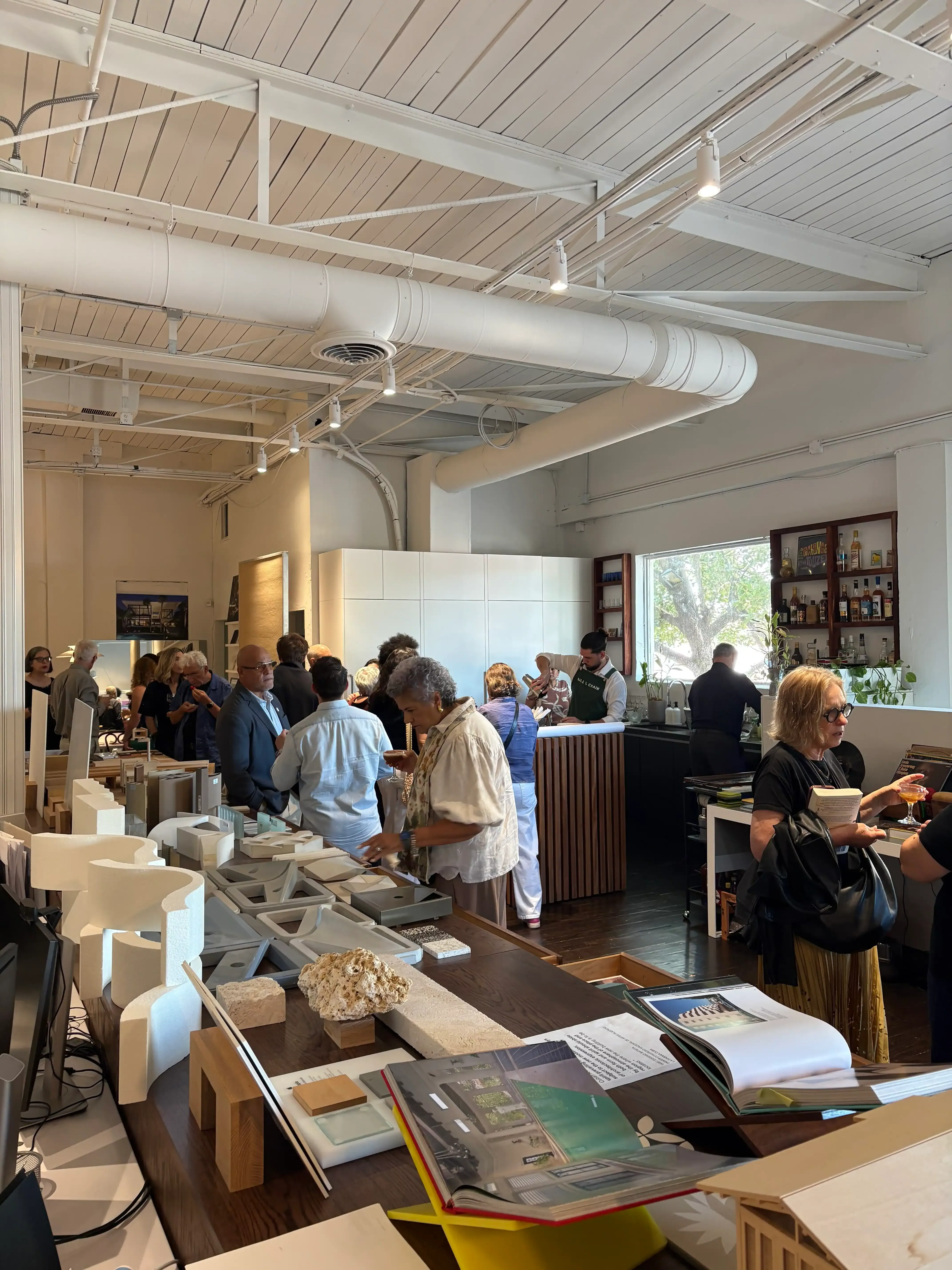
People who visit the studio almost always stop therefirst. They pick things up. They turn them over. They ask what something is andwhere it went. It has become a kind of conversation piece, but for us it ismore than that. Materials are part of how we think.
Meaning First
Every project starts with a story. We try to understand a place, its culture, its climate, its history and its landscape, and then find a narrative that connects people to it. Materials are how thatstory becomes physical. Keystone is not just a beautiful stone to us. It is the ground Miami is built on. A breeze block pattern is not just a screen. It is shade, air, privacy and memory all at once.
When the material and the idea support each other, abuilding feels like it belongs somewhere. When they don't, you can feel that too.
Mastery
To me, mastery is knowing how much and when. When something needs more and when it needs less. It is proportion and detail, but in a place like ours it is also water, sun, salt and wind. It is knowing how will weather, what happens at the joint, and how the pieces actually come together on site.
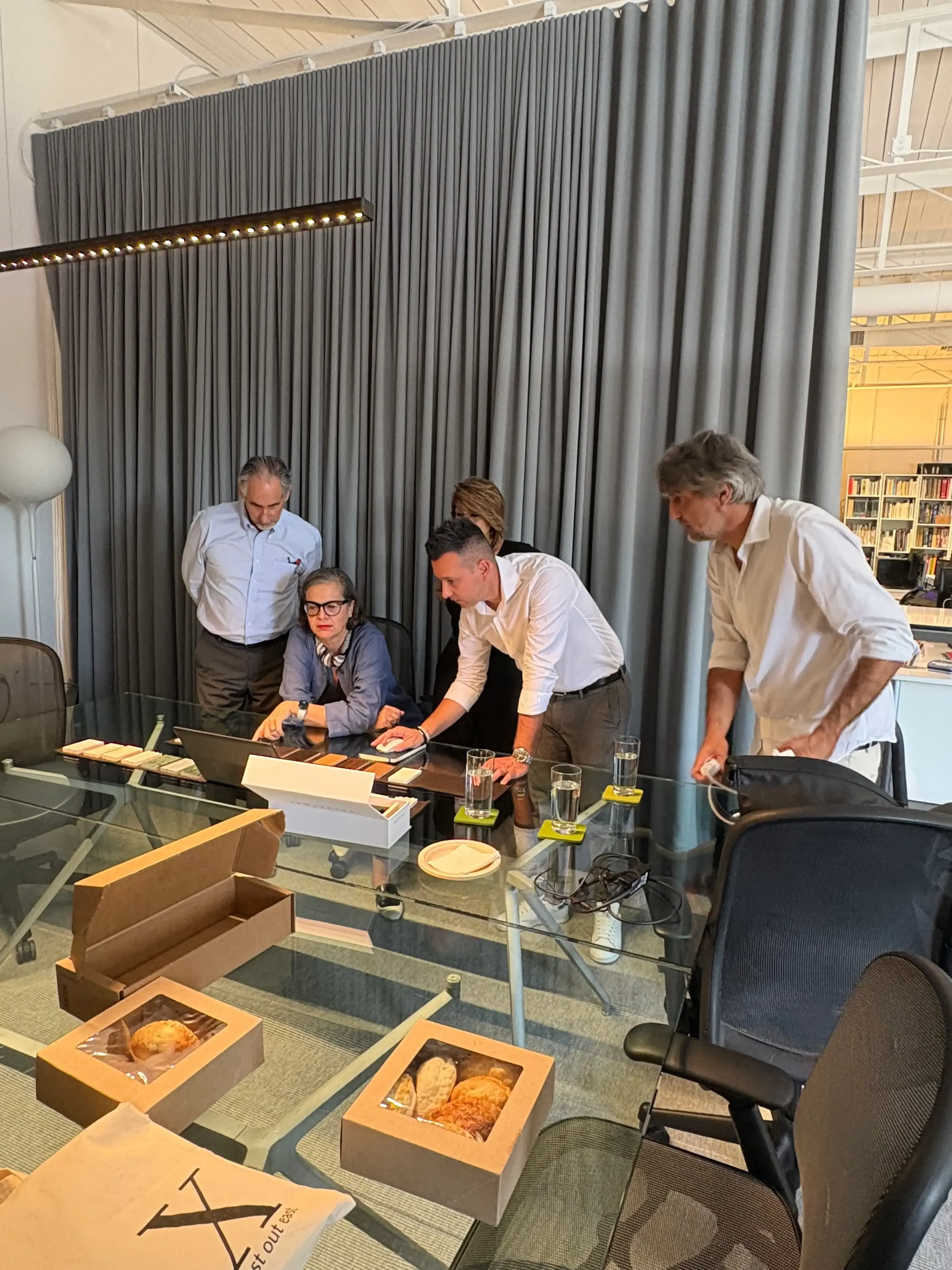
That knowledge rarely comes from a screen. Much of what I know came from drawing and detailing things, seeing them built, getting things wrong, and working with fabricators and builders who knew far more than I did. Some of our best moments in the studio still happen around a table with samples in our hands, holding a light fixture up to see how it glows, or comparing finishes side by side in real light.
New Tools, Old Questions
We use new design and visualization tools every day, and I love them. They let us explore more options, test ideas faster and communicate with clients in ways that were impossible not long ago. I have no interest in romanticizing the old way of working. A lot of it was tedious.
But I do worry that as an industry we are putting enormous energy into the tools we use to show a design, and not enough into understanding how it gets built. Architecture is still made by people. The knowledge of craftspeople, fabricators and contractors is one of the most valuable resources we have, and it is not being passed on as quickly as it is disappearing.
So I keep coming back to two questions. How do wedesign better buildings when fewer and fewer people know how to build them? Andhow do we keep craftsmanship from becoming a luxury, something only availableat the very top of the market?
I don't have complete answers. I suspect part of the answer is right there on the flat files: keep making things, keep testing, keep ailing in the studio instead of in the field, and keep bringing the people who make things into the conversation early.
.webp)
Join the conversation
I'll be exploring these ideas on the panel Designing for the Next Century: Materials, Mastery, and Meaning at the inaugural Dayof Design in Coral Gables, alongside Jorge L. Hernandez and Luciana Fragali, moderated by Harriet Mays Powel of Palm Beach Cottages & Gardens.
Tuesday, September 22, 2:45 to 4:00 PM, at the Coral Gables Museum.
.jpg)
.jpg)